Posts

Cassandra's Replication

Cassandra's Replication  Replication Factor: Replication in Cassandra can be defined as the number of copies of data present in the different nodes in the cluster. The main factor for availability in Cassandra is replication factor. Replication is set at KEYSPACE level. Example : If we have a 3 node Cassandra cluster and if we give replication factor as 3, then the data will be available in all the 3 nodes. So, in this case we can get availability even if we loose 2 nodes. Hence replication factor is the one which gives us high availability in Cassandra. The data will be stored in the cluster based on the hash value of the partition key. If the data's hash value falls under the particular token range then the data will be sent to that particular node. This node behaves as the primary token range. The storage of remaining replicas of data among the nodes can be described by using "replication strategies".  Replication Strategies:   There are two types of replication ...
Cassandra's-Gossip Protocol

 Gossip Protocol Cassandra uses gossip protocol to know the state information of nodes. The gossip protocol is named after the concept of human gossiping. This gossiping runs every second in the Cassandra cluster. We use nodetool command "nodetool gossipinfo". It gives the complete gossip information about all the nodes in the cluster. It gives state information, schema version, DC, Rack, Load etc. The nodes can gossip with any of their peers. If for some reason one node cannot gossip with it peers, it will directly go to the seed node which is given in the cassandra.yaml (main configuration file in Cassandra) of that particular node and asks the seed node to share the gossip.  Gossip protocols are also called as epidemic protocols. The main use of gossip protocol in Cassandra is "failure detection". Once per second, the gossiper chooses a random node in the cluster and initialize a gossip session with it. Every round of gossip requires three messages. 1. The gossip...

Cassandra CAP Theorem

Image
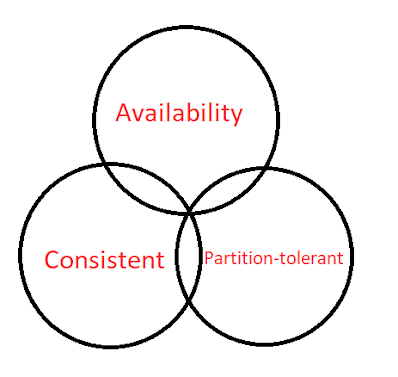
 Cassandra's CAP Theorem Cassandra's CAP theorem states that all consistency, availability, partition-tolerance cannot be given in one system. All the databases can have partition-tolerance but they must choose between consistency and availability. Cassandra is a AP database. It gives high availability and partition-tolerance and it also gives tunable consistency. We can tune our required consistency in Cassandra. But in Cassandra high consistency gives low availability. So we must choose our database based on our requirement.  CAP theorem is also called Brewer’s theorem. It is named after after its author, Eric Brewer. Consistency : All the users will read the same data for the same query, even when concurrent updates are done.  Availability : All the users will always be able to read and write data.  Partition Tolerance : The database can be split into multiple machines. It can continue functioning in the face of network segmentation breaks. Cassandra ...

Cassandra Keywords

Image
 Cassandra Keywords The main keywords which are used in Cassandra are Cluster, Datacenter, Node.         Cassandra Cluster                       Cluster:  The outermost layer in the Cassandra Architecture is a Cluster. Cluster may contain one or more datacenters. It can also contain one datacenter from US and another datacenter from India. This both datacenters may also become a part of one Cassandra cluster. As Cassandra is a highly available system if we maintain to different datacenters in two different places we can still get our required data if one of the datacenters is down due to some reasons.  Datacenter: Datacenter is a part of Cassandra cluster which contains nodes. It can have one single node or multiple nodes in one datacenter. The datacenter contains racks in which nodes are stored. By using replication strategies we can also place nodes of one datacenter into different racks. So that...

CASSANDRA

CASSANDRA       Basics of Cassandra Cassandra is a NoSql, distributed, highly available, fault-tolerant, tunable consistent, decentralized, linearly scalable database. Cassandra is a write heavy database. If your application is write heavy application then Cassandra is suggestable.  Cassandra is designed by using Amazon's Dynamo(for it's distribution design) and Google's Bigtable(for it's data modelling) with a query language which is similar to the SQL.  The basic understanding of Cassandra's characteristics: Distributed:  The data which is stored in the Cassandra is distributed among all the nodes of the Cassandra cluster. Hence it is a distributed system.       Highly Available: In Cassandra there is a replication factor which replicates the data into the other nodes makes it highly available.    Fault-Tolerant: In Cassandra the process of storing and retrieving of data is unstoppable also if there is a problem in one o...